


Only lovers left alive

The poem view is different insofar as we are interested in the original reality in which the vision of the poem (the film) was conceived. When we feel we're getting interested in the analogies between the the reality in the vision and that in the actual reality, than we are in poem view.
What we see is a junkie apartment, or two, actually. This is the opening shot, plus an old record player running, spinning slowly, which is what the camera is doing, so we feel it's a universal view, and that the record is the focal point in it, around which the whirling is happening. Like the eye of a tornado that took the house with Dorothy.
One of the two figures we see is Tilda Swinton. Her hair is white and big. She's in a robe, lying on the floor, in a decent position, the large bed being her head support.
The guy (Tom Hiddleston) kinda looks typical for a junkie. But we slip as we try to interpret what we see like that. Cause it is deeper. As it turns out.
The story begins to unfold. The guy is buying guitars. The scene is reminiscent of the Taxi Driver's gun buying scene. Better, nevertheless.
He likes vintage instruments, guitars, it seems. The whole thing feels very natural.
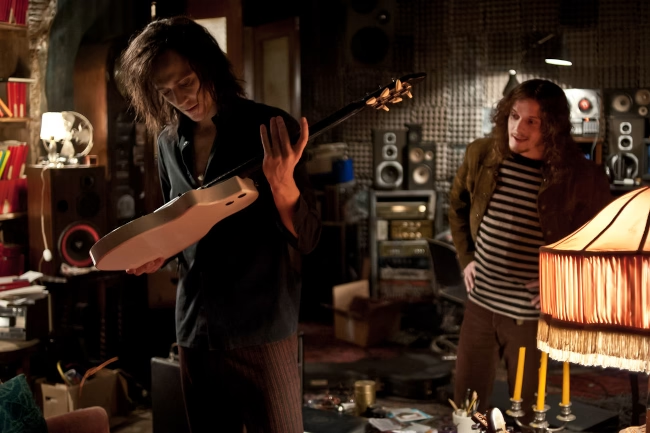
Adam with Ian, the vintage stuff dealer (Anton Yelchin)
Yet the milieu is weird. I mean, weird plus something more. We recollect the Jarmusch films we love, in my case, Down by Law and Stranger than Paradise. The analogy (which feels like a formula) is apparent: some guy lives in a milieu that is alien and weird to the viewer. He's native in it, and the viewer is curious, and also afraid or at least would prefer to keep a distance.
We kind of see a version of Lurie in East Village gambling, and Eszter Balint walking the dark streets, I mean, the vacuum in between the blocks, or Roberto talking with weird real-life guys (artists) in Coffee and Cigarettes.
However, at one point we say: stop, this doesn't exist. Sure it looks like another weird niche subculture, which we wouldn't dare to visit. Adam buying vintage stuff, is sure deep in a sci-fi reality, not to mention buying blood regularly. But at one point we realize that this milieu doesn't exist. It is just a movie set milieu.
We don't mind it, nevertheless. The film feels good. It is familiar. Plus the guy's face (Tom Hiddleston) is very clean. Opposite of a junkie's. Plus-plus, he makes a remark at the guy who sold him the guitars: for a zombie, you're all right. This takes us. We are with him. The fiction of the sci-fi works! Plus-plus-plus, it's all analogous with today's reality. I mean, we can call it yesterday, as it is 2026 now. But still. Or all the more.
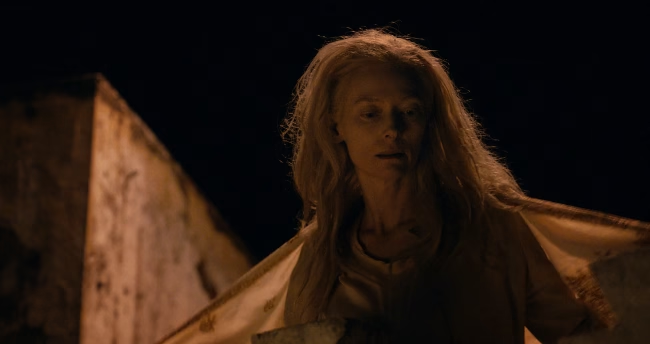
Then Tilda Swinton "wakes up", gets activated, and all of a sudden we realize that this is some sort of a time traveling trip, this movie. It swiftly crosses our mind that Orlando was a good film (I should finally get to see it! I haven't, cause I started listening to its OST, and it was like a movie, which I loved, and didn't want it to be replaced by the actual film.)
This time her name is Eve, while the guy is called Adam. She's talking with a guy named Marlowe, and they joke about the Shakespeare contemporary poet, but they don't stop at no point, and we get it: he really is Marlowe.
Now we understand why it was funny when Adam mentioned that he saw someone old and famous playing, and when they vintage dealer guy asked, did you really? And he answered, on youtube, of course.
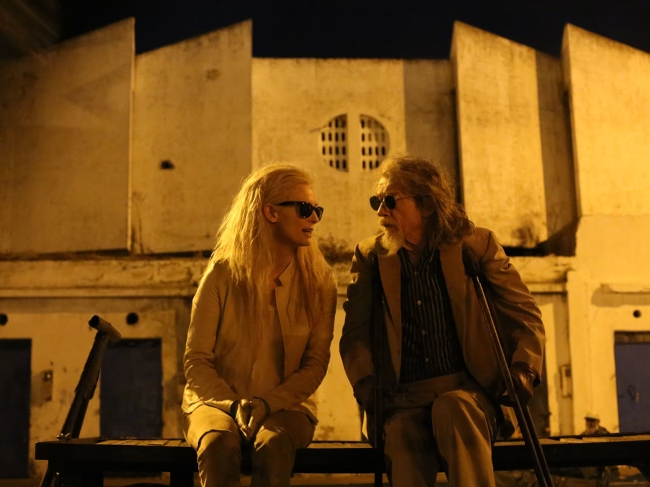
Eve with her beloved friend, Marlowe, the "kid" (John Hurt)
So the story is unfolding... and we're getting to like the taste of it. We tend to forget the ugly red Gothic letters during the main title of the film. (When I say "we", I just assert that it will probably happen this way with you or someone like you or me.)
We enjoy it. We sense an allegory, and might give it green light.
We feel invited to imagine the life in the good old East Village. Artists waking up every day. Walking out. Meeting some other people. Making calls. Saying stuff. They always perform. Their days are a permanent performance, with reflection on the whole of life, on civilization.
Can you imagine an artist like Jarmusch having to think about his outfit before leaving his apartment? Can you imagine that an artist wants to grab her/his sunglasses but realizes that s/he can't, cause those people outside might take a picture of her/him and it wouldn't convey the image that s/he identifies her/himself with? The image what s/he is? Rock stars typically wear shades. They live in their past. But a filmmaker like Jarmusch is totally rooted in the present. In every age. Through time.
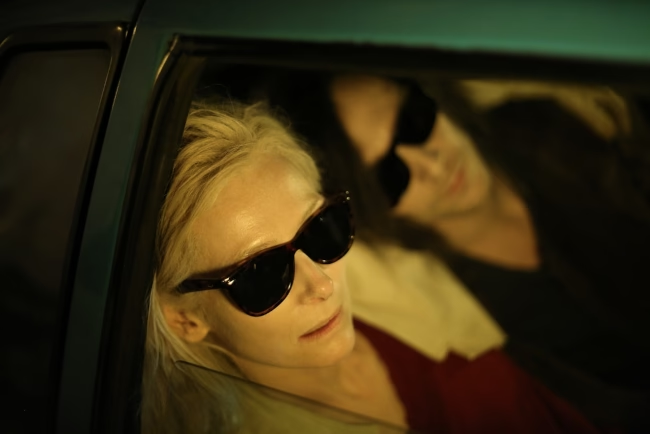
This film depicts a post-state in which everything has changed, everywhere. It is weird. This is no longer a "Kansas" whatsoever, the reality we were brought up with, or in, no longer exists. Everything is alien. Hence the analogy-clue to the "zombie theme". I mean, this is why it works.
Seriously, we empathize with the imaginary New York artists living in a reality whose root is in the '80s and earlier on. We empathize and sympathize... and we have this vague, dreamlike realization that this was all too familiar to be just someone else's reality or situation or case. Feels like it's ours, too. It's not about possession.
The strangest thing is that the guy plays music, he's recording in multi-track mode... The junkie house is a neat home studio. The music is not bad at all. It is also experimental. And cool.
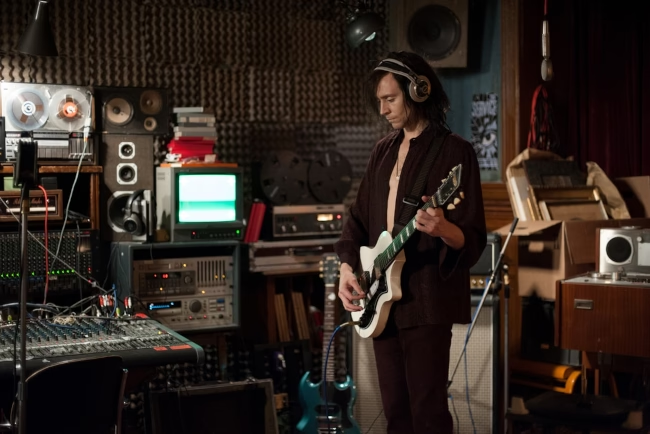
Adam (Tom Hiddleston) making music in real time
Then we are introduced to the fact that this thing with time and history is blended with vampiredom. They drink blood. The pure stuff. Too bad that the world blood supplies are getting more and more contaminated. Also too bad that back in the day, 2013, there was a vampire wave in Hollywoood movies. I'm happy I haven't watched any of them, and seeing this film convinces me that the vampire theme is not related to the Hollywood wave. Sure, it may have helped the production to get green-lighted, but the 2010 documentary by Celine Danhier, Blank City, an amazing and incredible and unrepeatable one, must have helped it much-much more. Either way, this is an original vampire story, for sure. This is emphasized by the wooden bullet thing. No silver shit. Garlic, hover, gets mentioned :)
This is simple and organic vampire story. Actually, it's not even about vampires, but rather about creatures who need to take to blood to feed on, which makes is necessary for them to have their eye teeth protrude, when it comes to doing that. Vampiredom is just a form of existence. Traveling through time. More precisely: drifting through time, cause unlike Bulgakov's Wolan, they can't go back and forth in time. They just exist, they don't even move, it is the world around that that changes and moves ahead in time.
So, how does it feel to live like a "junkie" (which is a close parallel to a zombie)? Seeing that the reality around you have turned into zombiness, with masses of zombies? Weird, isn't it?
We truly sympathize. It's not hard to get to like the taste of this film, and then you begin to like it, more and more. The spinning of the record in the opening shot is getting you. By around now, the whole world is spinning.
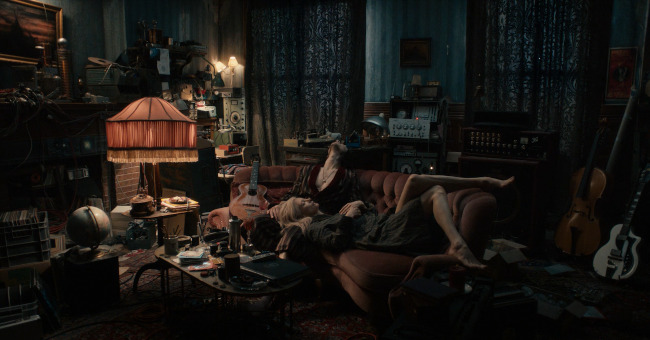
Jarmusch sports body-position shots. They are like 18th century (1900's) oil painting, before Manet and impressionism. Extremely beautiful.
At firs he only shows Tilda Swinton's legs, which look incredible, not independently of the pale-white skin color. But then he gets deeper into it with shots that speak more than the traditional 5000 words, as the image to words ratio. Visual story telling, this is. On our part: visual story sensing.
Then a turn in the plot comes, in the form of a younger girl, Ava (Mia Wasikowska), who stirs trouble, acting like a teen. By today's terms she's totally decent and modest, but still. She brings this whole vampire-thing to a funny ground level... Where do you keep it? (the blood supplies). Give me one more sip. Pass me the flask. Etc, etc.
Then, guess what: things that have been going on smooth throughout centuries and thousands of years, now go astray. Glitch happens.
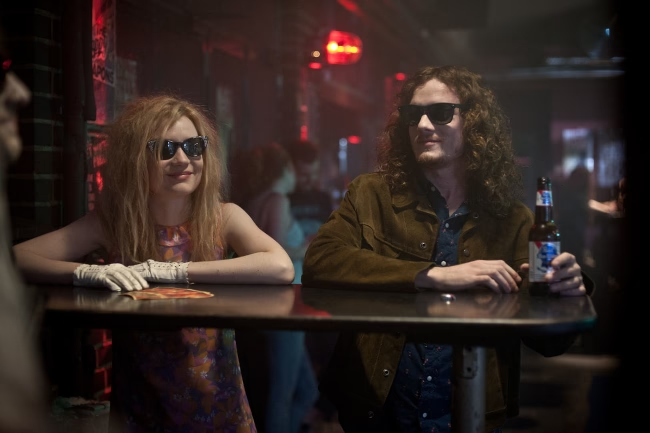
Ava (Mia Wasikowska) and Ian (Anton Yelchin)
The entire serpentine which began at the, well, the beginning, with that small-size record on a record player, gets in third act mood. It works. We feel that it was necessary that some things change.
the end
Then there is an inexplicable scene (notice that I'm taking jumps and don't tell everything): a musical performance, a concert at a bar in Tangier. The girl is super sexy, singing barefoot on a carpet. Her name is Yasmine Hamdan, and she's from Lebanon. The audience seem to know her song, like an ancient story, or like a prayer. Adam really likes the music, and we understand it.
The last scene is for the movie goers, incorporating some universal theory, which to me translated like killing everyone and leaving but two is somehow equal to killing two and not killing the rest. Or something like this...
The film ends. And we get something that we didn't expect.. although, looking back, we could have... Music, namely. The film ends with a very cool music. Reminds us of the Samurai experiments, but way-way better. Also better than the Broken Flowers OST. It is pure gold.. or blood :) Pure, for sure.
So, at the end, all the story and the experiences distill into a drop of substance: a piece of music. It is universal law that an entire film is as good as its end title music. Were it bad or not perfect, the whole film would inherit that quality. But it is pure. Plus, it comes after that Yasmine Hamdan concert, which means the end of a journey, somehow (Eve gives Adam an Arabian instrument as a gift, and the end-title music features that instrument). Well, music has been, obsessively, the main thing since the beginning... and it truly is so at the end.
All I know now is that it was great to spend these two hours with Jim Jarmusch and his friends.